Story behind the Passage
I am quite diverging from my original plan of talking about startup stories today — but maybe I will not. I have no idea. Let us see where this is going. I just know that I need to write about ghostwriting today because I talked about it a lot this afternoon. And whenever I talk about this topic, this passion, I get very excited and happy. It is such an amazing story, it is my story! But ghostwriting, despite the fact that it has turned into my own analog ‘startup,’ is also a big mystery to me. And mystery is a good keyword for discussing today’s passage.
A little while after I had done my first books with clients, I started looking for literature and other sources about ghostwriting. This turned out to be a difficult task. Whenever you enter “ghostwriter+research” into Google, plenty of ghostwriter agencies will come up that offer to write scientific papers and other texts for you. But only very few links really contain information about ghostwriters. These you can search for by using their actual name which you find via the books they write, i.e., many of them are mentioned on the covers in the role of “contributor.”
In the course of this introductory search I did on ghostwriting as a profession, I also came across the mystery novel The Ghost by Robert Harris. I had no idea who Harris was but the blurb promised that this would not just be a very catchy title but that the book would actually be about the story of a ghostwriter who is asked to write the autobiography of a politician and then happens to experience a mystery story of his own while working on the project.
I remember that I very much enjoyed reading the story but I definitely did so because I was so much into the details of how the ghost in this story does his job, i.e., his interviewing techniques, his sytem of note taking, his attitude towards the client, etc. Of course, this is a fiction book but, hey, who could invent all these nitty-gritty facts about ghostwriting better than a best-selling fiction author (Harris)? Of course, this is speculation now, but given the fact that most authors do not go from “0 to 1,” as you might say in startup lingo, i.e., they do not become best-selling authors from one day to the next or stay on the bestseller list forever, the chances are high that he at some point in his career was ‘in touch’ with ghostwriting, to phrase it carefully.
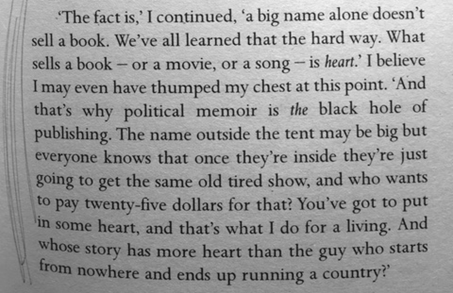
When I opened the book just now before starting to write, I went to the first page that I had marked with the characteristic dog-ear. And there it was… This passage above jumped right at me and it is so much in line with what I talked about today with my friend Tobi (yes, you remember Tobi from the “Prologue”)? He was the person igniting the blogger fire in me. We talked about “fire” a lot today, I mean, in a figurative way. We are both people who have so much passion and energy that we cannot stop ourselves from spreading it to others. Of course, this only works when you do “your thing,” when you spend your entire day doing things you really enjoy. Even though, both of us might be doing very different things, there is one thing that deeply connects us: stories. We love them, we believe in them, we listen to them, and we tell them. Just like the Ghost in Harris’ book.
My Learnings
“… a big name alone doesn’t sell a book.” This is quite a tricky sentence to start with because it is only ‘correct’ if you read it conjunction with the other sentences in the passage. By itself, it is not quite what you find in reality, at least in my experience. When you try to sell a book to the publisher, a big name is THE most important thing that at least makes them consider your story. It does not automatically mean that you will get to publish your book, but without a “big name,” it is almost impossible to win a contract. At least, this is how it works in Germany and the many articles that you find about “how to publish a book” online give testimony to this.
However, as you might have guessed already, there are surprising and very encouraging exceptions. If you know me a little bit by now (is there anybody reading me, by the way?), I often end up finding some exceptional approach to quite unexceptional challenges without even realizing it at first. So, what I am trying to get at is that the STORY does matter. It might be naïve to say this after only a few years in business but it happened to me that a book was accepted at a point when neither I nor the authors (the people whose names appear on the cover) were “big” already.
The reason why I am saying this is because it makes a terrible difference to how you step on stage as a young entrepreneur to tell your story. And no matter where you might give a speech and on which topic — you will always be telling a story. If you are not aware of it, however, you might tell a bad one. But that is not even my point. What I am saying is that you need to be convinced of the fact (and it IS a fact, this is what Tobi and I totally agreed on) that your story is the key to your successful future.
I know, this sounds terribly marketing-lingo-like (which I hate) but I cannot help it. It is really what I have learned in business and life, especially in the past two years. And if you fully trust in your own story when you share it, people will notice and they will follow every word and every gesture you are sending out. This will not happen if you are convinced that nobody is going to listen anyways until you are a “big name.” Bullshit! As we know from Startup Best Practices 101 (hey, I should actually start teaching this!):
“Fake it will you make it.” — Aristotle, origin
And you will make it even faster this way! — Silke
“… they’re just going to get the same old tired show, and who wants to pay twenty-five dollars for that?” This is a fascinating sentence if you compare it to the startup and business world in general. The ghostwriter is referring to the genre of political memoir here. And what he is saying is that, despite all the big names in this “tent,” there are hardly any surprises that would make it attractive for people to read the book. Is that not sooooo right? Think about the last biography of a politician you saw in a book store or maybe even just in the showcase of a book store while passing by. Did you actually buy it? Did you even consider buying it for a second? And even if you did not buy it yourself and somebody gave it to you as a gift, what would be your expectations concerning the content? Yes, exactly. Childhood, went to a ‘big’ university, met many ‘big’ names who helped him get a ‘big’ position which then allowed him to get ‘big’ in politics and finally climb that ladder to the top of the state until there was no ‘bigger” anymore. And, to make it a bit less boring, there would at least be some allusions to extra-marital affairs or other scandals. Is this not what these books are usually like, at least in your imagination — in your “image” of the genre of political biography?
Yes, and this is exactly what the ghostwriter is saying here why it is so tough to write these books. I have no experience with political biographies but you can actually transfer this thinking to ALL genres, at least, if people have some basic knowledge of different genres. So, of course, you could ask: Hey, why buy a crime novel? You know what is going to happen — dead body, police… Or, think of a romance — you know what is going to happen: Two people (at least), meet, fall in love… But, hey, all these books are still being written and sold, right?
Sure, I am oversimplifying things again but only to show you that, of course, the name of the genre and even a particular plot (e.g., the tale of the lost son, the quest of a hero…) are just that — general frames in which to position the real story that is going to stick in the reader’s imagination. That means: just like there are close to eight billion people living on this planet who are all different, our stories will also always be different (even if we try to copy 1:1). There are endless combinations of creative thoughts that can be reassembled and rearranged in unlimited ways and media. How is this related to business/startups?
Every startup is about bringing innovation to the world, with innovation meaning anything, also non-digital products. But, honestly, there is no real innovation in this somewhat totalitarian sense, as people sometimes refer to it. There are only innumerable combinations of the known. This might sound strange because — why would you then spend millions of dollars on research and development then if what you get is what you had in the first place? Again, these combinations of ‘familiar’ things to form innovations do not just happen — at least usually. Of course, they cost work and time and nobody is saying that what you get is exactly what you had before. We are talking about the different parts that form the whole big picture. And what I am saying is that you do not have to change every single piece of the picture in order to still arrive at some new combination.
In other words: Just like the ghost is getting at here in this passage — there is no reason whatsoever to stop innovating just because innovation is based on combining the known. This in and of itself is what innovation is all about and it is something that takes expertise, experience, skills, and — yessssss, this is where we are approaching the most important element now…
“You’ve got to put in some heart, and that’s what I do for a living.” You have to know that this passage is from the beginning of the mystery when the ghostwriter is still fighting to win the contract (not knowing about the trouble that this will cause him). “Some heart” is the major ingredient to avoiding the trap that a political biography ends up as a shelf warmer. But the statement gains even more relevance in connection with the latter part of the sentence — i.e., doing this “for a living.” Is that too ‘fictional’ to be real?
I would definitely say: No! And I think, this is why there might be so many academic ghostwriters but not so many ghostwriters writing biographies or non-fiction for politicians, business people and whoever else wants to write. I am fully convinced that the heart is the key but not even with respect to the book as the product. The heart is the key to the story. I do not mean this in any sentimental way or so. But it is simply not possible to ghostwrite based on rational thinking only. It cannot work, I really do not think so (Please, if you read this and you are a ghostwriter who is writing biographies and non-fiction with people and you think you are working in a completely ‘rational’ mode, shoot me a message).
Ghostwriting, even more than all other writing, depends on empathy for the most part. You cannot put yourself into the position of someone else, use his words, see the images in his mind, and even feel the same thoughts of this person without empathy. And empathy, again, is not a rational thing. You cannot take a course on it, read the theory, and then work your way from one item to the next. It needs to be there, all the time, throughout all the hours that you are listening to the story. Only then can the words paint a picture of the person who uttered them. Only then can a ghost unfold all his power. The power of a person whose talent and joy it is to see the world through the eyes of someone else.
If this someone is not just a “big name” sitting in a tent giving an “old tired show,” the journey that the ghost and the client embark on will form a story of its own. And I wish that more ghosts would write down these stories, just like Harris — be it in works of fiction, non-fiction, or otherwise. But, my guess is, this is not even our strength. Maybe some of us are doomed to be ghosts forever. We only feel happy and whole when we are underneath the skin of someone else — making sure that the words that have been buried and the feelings that have been silenced flow on paper.
Yes, “what sells a book… is heart” — how could it be otherwise?
Reflection Questions
1) What are goals in your own business life that you think you can only achieve with a “big name”? Focus on these goals now and write down some measures that you could implement right away to reach them. When you are done with writing, ask yourself again if you really need the “big name” first.
2) How do you think about the thesis that all innovation is “just” a combination of known things?
3) How much heart do you put into your business? Do you sometimes wish it were less/more? Why?
Learn more about Silke’s 365 Days Blogging Challenge
Schreibe einen Kommentar