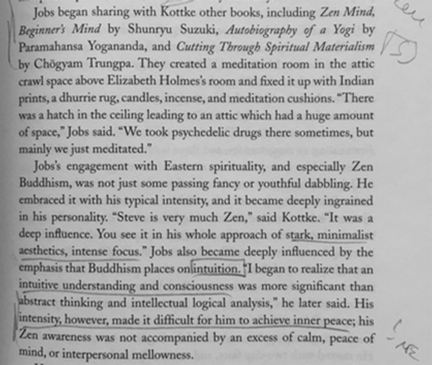
Story behind the Passage
This might be the third time that I am blogging about Steve Jobs’ biography but so it may be. I used the passage above in a presentation today. As I was putting it together, I became aware of the immense difference between “foundational research” and “application-oriented” research. I have no idea if that difference really is as big as I am seeing it right now but it kind of hit me in the face that I am taking the second step before the first with something I am planning. Now, of course, I would not be able to take the second step had I not done the first one myself. But the issue is, as always, one of communication. Explaining step two to someone who has not followed step one is difficult.
This made me think more about the quote itself and Jobs again. Learning to build software and hardware already is applied research. Building a business based on entrepreneurial knowledge is application. But building methods to teach people entrepreneurship with new methods that still come from foundational research which I have not published yet, sounds quite weird. The thing is: This is just how I think. Whenever I read something ‘theoretical’ I think about how it can be used to fix some problem. Then I think back of what type of research is needed in addition to the existing one in order to fix the problem even better. This is also the point when publishing anything about the existing research already appears outdated for me and I rather come up with theories and concepts for new research.
Hmmmm.
The reason why I am thinking about this in relation to Steve Jobs is, of course, because he was such an innovative mind. And by innovation I always mean creative in solving problems. Building hardware for people around the world is something that only very few people on the planet have done successfully to this extent. But the point is, even though he was not a researcher, research was his life. Every entrepreneur is a researcher, a chronic one. You scan the environment and learn all the time. There is no end to it. As soon as you have a vague idea about a new prototype, you immediately start testing it. And whenever you have no answer to the next step, you do “theoretical research.”
This brings me to this weird and mostly tacit definition of theory which people seem to have in their heads. I still do not really understand what it is, even though people sometimes tell me that I am theoretical. And I tell myself I am theoretical. But for me, there really is no difference to “application” because my mind always thinks about what to do with everything I see, learn, and study. So, when I then read the passage about the influence of books on Jobs, especially when it comes to spirituality and its impact on Apple products, even the Apple philosophy, I realized that Jobs thought the same way. Most of the entrepreneurs I know and read about thought/think that way. Now, here is the tricky issue: Maybe the problem is that there is a huge bias in what I read and other people, i.e., non-entrepreneurs, do not think that way?
My Learnings
“It was a deep influence. You see it in his whole approach of stark, minimalist aesthetics, intense focus.” This reflection of how Zen factored into Jobs’ thinking and ultimately into everything he built is the perfect example of how something so seemingly abstract such as philosophy or spirituality can manifest itself in something very tangible, namely products. Of course, in the field of design, this is nothing new. If you equate design with art, there is nothing new either. It is self-evident that spiritual and cultural influences affect artists and designers in any field. But the point is, when you think of application-orientation and entrepreneurship, there is always the issue of problem solving involved. You do not just build the product in this or that way because it might please your personal aesthetic needs. You build it this way because you are sure that it meets market demands, that it actually helps people solve their problems even better, more effectively.
Again, this was how Jobs thought and this is how I think, even though I will never build computers. Maybe this is what people call “transfer” — I do not know. It is natural to observe natural principles in the world and then transfer them to business. But maybe it it not. If it is not, I have a problem. I have a severe bias in the way that I think about people’s thinking. Maybe there are simply some minds that always think in terms of applying stuff and maybe there are some that never do, or at least not at the same time. If the latter is the case, I have a huge problem. How can I explain to people what application orientation actually means? I know that people probably know what application in and of itself is. But the step before, the transfer of theory to practice which is so natural to me and many others, might be highly tricky. Otherwise, people would be employing an application-oriented mindset all the time.
When it comes to Jobs, his thinking was not just application-oriented, it was also timeless. This is the crucial thing that really makes people stand out. The principle of simplicity which he identified in the timeless philosophy of Eastern spirituality will never become outdated because it reflects universal and thus eternal human principles rooted in natural laws. He saw this, he internalized it in his own life, and he expressed it in his products, thus also bringing this culture of simplicity to the clients, i.e., to the public. We are still affected by this up to the present day. Whenever we use an Apple product, we experience how easy it is to have everything available just three clicks away. And how “addicted” you get to this, you only notice as soon as you do not have it anymore.
Then you do not like the other products anymore.
Just like I do not like to not think application-oriented anymore.
Reflection Questions
1) What does simplicity mean to you?
2) How important is “intuition” for you when you make decisions?
3) Do you think that philosophy and/or spirituality can bring about “inner peace” to innovation-driven business leaders? How exactly?
Schreibe einen Kommentar