Story behind the Passage
Last week, I did not make it through the Carson book. Today I did — kind of. I have to admit, the book is so dense and so full of profoundly researched examples that I was not able to read and digest every single one of them. But that makes the book even more memorable. And one has to remember that it was exactly this accurate research which led to the political explosiveneness. Carson gave so many examples of how chemicals were being used in different locations and states of the U.S. and how devastating the policy making — or the lack thereof — was for the environment. This brought her the hatred of politicians but it also brought about the fact that more than 50 years later, the book still counts as a breakthrough moment in the environmentalist movement. Carson thus was what Greta Thunberg is for the current generation. She did not shut up and she decided to use her voice as an author to draw attention to those “who” could not speak — the plants and the animals.
1. Neglecting Knowledge
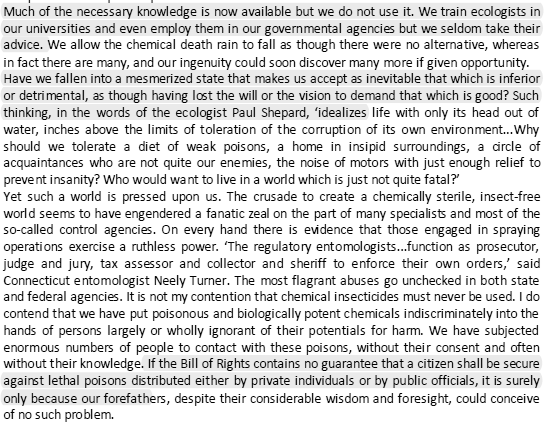
Is it not so timely to read this? Are you not reminded of what happened during Covid? At least if you are German, you probably know what I am talking about. All the scientists presented their data and models from the beginning of the pandemic but the politicians decided not to listen. Instead, they relied on their ‘personal assessment’ and their longing to win the favor of the public. This brought us a total of three severe waves, endless lockdowns, and many deaths. Of course, Carson is not talking about Covid here but you can transfer the situation. She is talking about data that modern science can give us about what happens to the environment if humans do something to it that is not in line with nature — or they do nothing to stop other humans from doing this.
In all of these cases, we are seeing backlashes to pre-Enlightenment times, I think. We have invested billions of dollars into research and development to then ignore the results. But, of course, we have to differentiate. On the one hand, you have the foundational research that is not geared towards any kind of specific goal and actually has human wellbeing as the humanistic aim. On the other hand, you have what industrial research makes out of this. And this, no matter how innovative and economically valuable it might be, can quickly turn into the opposite. This is what happens if big companies produce chemicals that then kill the bugs and the birds and the food of the birds as well. Carson’s book is full of these examples.
As Carson also hints at in her remark about the Bill of Rights, many of these problems of destroying nature are so far away from human nature that they were probably hard to imagine in the times of the democratic forefathers in the U.S. Maybe, one might ironically ask, the time of witchcraft and superstition was even “better” for nature since people blamed all evil on supernatural powers instead of trying to come up with chemicals to fight viruses and germs? For sure, this might have cost the lives of more people but maybe this conclusion is too near-sighted? Maybe it would have saved the life of nature which now is the reason why many people die because there is a man-made imbalance that makes it possible for all kinds of unexpected catastrophes to kill even more of us?
2. Endless wartime damage
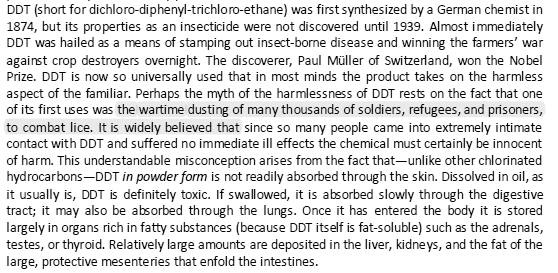
It is quite sad how often Germany appears in the text. And most often, the names of scientists from Germany are related to years that start with 193- or 194-. Yes, in most of these cases, it becomes very clear how much war is the engine behind innovation. As in this case of DDT, the chemical which Carson elaborates on throughout the book, it had been invented earlier but came to thrive in the war years, as she explains. The same holds true for other examples she mentions in relation to U.S. military inventions around this time. In all these cases, in extreme times, people set most priorities. And killing or defending oneself is usually the most important priority. Everything that distracts from this, is in the way, including lice in the example. So, chemicals meant help, no matter which other consequences there were. You shoot a fly with the weapons that could kill an elephant, no worries.
Unfortunately, I am writing these lines in days when we are again seeing a “war” happening in the Middle East. It is not a war in the conventional sense of the term between nations. Still, we also know how much military innovation is part of Israel and how this has led to its economic success. And you can mention a long list of other nations to which this applies, including Germany, of course. It seems that human genius needs extraordinary times in order to flourish. I am not saying that this only has bad consequences. As we are also seeing in the pandemic, this pressure of seeing many people die also caused scientists to come up with innovative medical solutions a lot quicker than in normal times. But really, now as I am writing this, we also know that the scientists are not really the problem. The problem is the bureaucracy behind all this that hinders the innovation process.
When reading Carson’s book, you find so many examples that remind you of the present. Above all, the book somewhat confirms my overall impression that nature has many good reasons to strike back; to claim back the balance that human beings take away from it on a daily basis. This is just, I think, no matter how cruel it becomes for us. We have lost touch with nature to such an extent that the current efforts to reclaim circularity, the basic principle of nature, will take a long time to really take effect. As Carson also writes at the very beginning, most of the damage is already irreversible. We cannot revitalize lost lives and we cannot revitalize all the animals and plants that have died because we killed them. Carson’s book is a wake up call to stop this killing. And I want to close with her closing lines to let her pathbreaking courage and intelligence resonate in your ears and hearts:
“The ‘control of nature’ is a phrase conceived in arrogance, born of the Neanderthal age of biology and philosophy, when it was supposed that nature exists for the convenience of man. The concepts and practices of applied entomology for the most part date from that Stone Age of science. It is our alarming misfortune that so primitive a science has armed itself with the most modern and terrible weapons, and that in turning them against the insects it has also turned them against the earth.”
Reflection Questions
1) When do you feel most connected to nature in your daily life?
2) How do you define the concept of sustainability?
3) If you were an animal — which one would it be and what would you ask of humanity?
Schreibe einen Kommentar