Story behind the Passage
Today was a life-changing day for me. That has private reasons, however, and I am not going to address these. It was also a remarkable day because I became aware that the solution to my personal branding problem is very easy as well. What people want from me when they approach me is always the same thing, no matter which arguments and alternative words they are using: They have a problem and they believe I can help them fix it. It is that simple but it has taken me so many years to actually pin it down. Part of the reason why I was not able to pin it down specifically is because I probably did not trust my own capability.
That might not necessarily explain why I am choosing a passage from a consulting book but it might as well explain it. I bought many of these books in the past, especially in the years when I wanted to do consulting as a career. Now, I looked for them in my shelf and could not find them because I actually gave them away to people who needed them for their case interview preparation. Well, case interviews are a red flag for me but that is a different story… What I am just trying to explain is that I have quite an intimate relationship with “consulting” and that is also why I started rejecting the label. Still, I come back to it today — why?
My Learnings
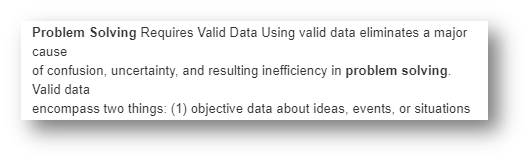
“Using valid data eliminates a major cause of confusion, uncertainty, and resulting inefficiency in problem solving.” This is something that came up so clearly today — it literally hit me in the face. Instead of always thinking about some creative ways to sell something new and exciting and innovative, I should have simply listened and watched myself a bit less emotionally to figure out what I am actually doing. And this is: fixing problems. It is that easy; at least the label. People come to me because they have a problem. I am repeating myself here but this is essential. And I should have learned earlier that writing books and offering other services is not the most efficient way to fix problems.
I am not judging the fact that people and companies have problems, just to make this clear. On the contrary, I am assuming that human beings are walking miracles and that also means we all have so many different problems. There is no human being without a problem which is also why I am rejecting to just see problems on legs while encouraging people to not see themselves like this. In case of companies, however, it does make sense to solve them on a higher level because then you can actually solve the problems of many other people as well, i.e., your employees.
So, what is new about this?
Nothing! I am not saying this is new. It is just new that I am beginning to embrace the concept of a “consultant.” In the past, I rejected it. I did not want to be a consultant because I wanted to be something special. That was not just for some profane ego purposes. It was also because I did not want to offer consulting for the reasons stated above. Yet, besides all the negative associations I have with the term, I should have realized earlier that solving real problems is very much associated with the role of consultants. That is what it is. And the issue of validation is key for problem solving.
Yes, I am always the one preaching trust in gut feeling and so on. I am still holding on to the importance this has. However, in a meeting today, I observed myself thinking and speaking and it was very clear how much I am into “rational” problem solving in connection with — and that is crucial — intuitive problem sensing. What I said was: “All of my spontaneous answers to your question would simply be speculation. We need a thorough analysis first to find out about the real reasons behind the decline.” And guess what — any McKinsey consultant could have uttered these words. Maybe, scholars are just that: number crunchers in disguise.
This sounds like I am starting to celebrate consulting now. That is not true. I am just so sick of all the inefficiency hat could really be prevented. There are enough problems that really need a lot of attention and resources. We should not waste additional money and manpower by not getting to the roots of things. That indeed will only end up in more uncertainty and more chaos. Nobody needs that, especially not companies that are employing many people around the world.
When talking about employing many people”, this also reminds me of another conversation from yesterday when a friend of mine tried to get to the core of my motivation. When I said: “Giving people a job,” she did not really buy it. “Do you really get up in the morning saying ‘oh, I want to give people a job today’?” She was right, of course. The real reason for doing things is usually a lot less “social” and much more hedonistic. In one word: fun (you can call it purpose but really it boils down to fun). For me, this is again very much related to problem solving: It is the adventure of really getting to the core of the problem, finding the causes, contributing to the solution. That is rewarding indeed.
And it is so simple.
Consulting is the name of the beast.
Let’s rock it.
Reflection Questions
1) Do you like problem solving? Why/not?
2) Which “data” do you usually rely on when trying to understand a problem?
3) What is your main motivation for doing the job you do?
Schreibe einen Kommentar