Story behind the Passage
There are so many endless circles, I cannot count them anymore. There are always two results: interdisciplinary and intercultural dialogue are the catch words. But the funny and the stupid thing is: The two fields of dialogue are the same! It is just that people do not see them this way. I have no idea why that is. The theories, tools, and skills you need to understand and deal with conflicts between disciplines are exactly the same as in intercultural dialogue. Why is it that the world functions according to keywords — catchwords — buzzwords? And, no, I am sorry, this is not about making simplifications here. I am well aware that Germany and the UK, for example, are different things than Physics and English Literature. But on a little more abstract level, both are cultures. Why is this so hard to understand?
Well, in any case, my little self-reflection took me back to opening Sher’s book again. As I mentioned before in the context of Anne Heintze’s book (# 140: Freeing the Inner Rebel. Story behind the Passage | by Silke Schmidt | Feb, 2021 | Medium), Sher is the mother of scanner (= multi-talented polymaths) coaching. With Refuse to Choose, she wrote the Bible for people like me. The thing is, when you learn that there are others as crazy as you are, that does help at first. The problem is, you still fall back into the trap of wishing it were different at times. This especially happens if you have the feeling that none of the things you are doing are leading to results. Or you have the feeling that all these things are leading to results but you should continue doing them the way you might have done them before you started talking to all kinds of people and before you read all these books about scanners.
The greatest thing about entrepreneurship is that you learn to combine fast pace with patience. This means that you act quickly but because you are quite busy all the time doing many different things (which scanners like if their creative talents are tackled), time flies. This helps you keep on doing stuff that you might otherwise quit already. And it keeps you from changing big plans all the time. So, all this helps very much to generally pursue long-term missions while being very active on a daily level. The problem still is: If you have the feeling that you do not know the overall mission you are on — there is no way to be happy about all this.
Well, being happy is of course possible every second of the day. But there is this long-term voice inside that wants to know what is going on. Then the either/or fallacy can kick in.
My Learnings
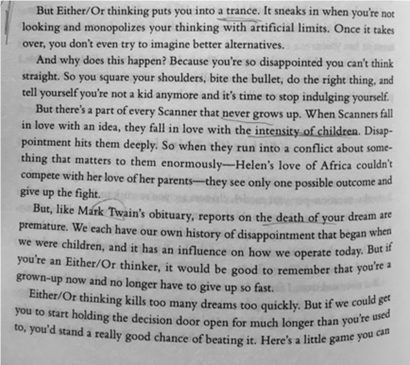
“Either/Or thinking kills too many dreams too quickly.” I know very well from which perspective Sher is writing. What she says about either/or thinking is what can literally drive polymaths nuts. Because you have this intense longing to live out all your interests, you force yourself to only focus on one because this is the thing that most people do and what they suggest you do as well. But even if you manage to do this, i.e., focus on only one thing, you suppress all other things. This can make you sick, I mean, really sick. And then, you start blaming yourself for not being able to just do one thing like everybody else. This is how the vicious cycle continues until, finally, you read a book like the one by Sher and you realize that not your interests and many talents are the problem, the problem is your inner condemnation of this because you want to be “mainstream,” like all others.
For scanner types, mainstream is not an option.
So, obviously, this explains why either/or thinking does not lead anywhere. But while I know all this, I have also come to the point of knowing that either/or thinking does have its advantages. This especially applies to the aspect of time. You can think either/or if you are aware of the fact that this is just a decision that applies to the present moment. I think, Sher also describes this somewhere else in the book. What I am saying is that you do put yourself under pressure to only do one thing for now while also making it clear that after completing this task or project or after living out this particularl thing you want to do, you can make a decision to do the other thing, i.e., the “or.”
The reason why I have arrived at this appreciation of either/or is very simple: experience. Everything I did in the past that was really successful came into being based on a very simple strategy: I focused on one thing only and with all my energy. The latter aspect made me sick in the end but, the important thing is, I got something done. Now that I am doing many things, I also get things done but I am not happy about the magnitude of these things. Yes, this kind of assessment requires comparison and comparison is usually the death of creativity. Still, just like the scanner identity, this strategic top-down thinking is also part of me. And I think, I have not appreciated this part in me to the degree that is necessary for turning it into value.
Somebody told me today that my “keybord” of options is much broader with respect to pushing my mission of fostering theory/practice exchange in higher education. He was right. I know he is. I have tried to deny this fact but it is true. If my criterion of decision-making is maximum social impact, then following the path that allows me to have this impact is not only logical, it is necessary. And this might be the most important lesson of all these years. Big impact does not come overnight, no matter how much the startup world makes you believe it. Real innovation comes through research, there is hardly any way around it. If you have research DNA inside, why would you not use it?
Either you make something of it
Or you do not.
There is quite some power in binary thinking.
If you still remain aware that there is always something in-between.
Reflection Questions
1) Are you an either/or thinker? When is this helpful?
2) Can you understand people who feel really bad if they cannot pursue all their interests? Which suggestion do you have for them?
3) Do you think that work should be fulfilling or is it a better strategy to divide passion and duty?
Schreibe einen Kommentar