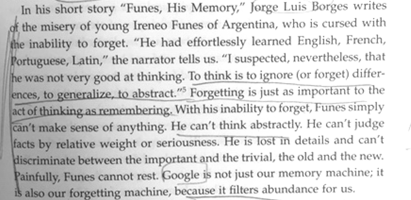
Story behind the Passage
This time, I do remember when and why I bought this book. Or at least, kind of. I listened to a lecture by the author at an American Studies conference. I did not like the lecture but I was hoping that the book would reveal some interesting information. It did not, actually, not from my perspective. Even though it is an important topic and a sound study, I simply did not like the overly critical approach. Even though the book is hardly 10 years old, I wonder how the author looks at his own thoughts from today’s perspective. Actually, I do not have to “wonder” — I could just Google it, right? I would surely find recent articles and talks by him. If he is like any academic, he probably still talks about the same stuff as if it were new.
This is why I will not Google it.
The reason why I am stilling talking about the book today is because I had a conversation this afternoon in which we also discussed the current decline of brain power among university students and other people off campus. Covid is probably making this a lot worse. In any case, even though I am on the positive side of anything (yes, I am), this is really worrying me. We can see it everywhere. People posting stuff they read somewhere. But they are not able to create anything themselves. This is not only because they cannot write properly anymore. They cannot read either. Hence, they cannot think about what they read. So, if we do not watch out, people forget what thinking actually means.
Well, it is probably too late for this.
They have forgotten already.
I really wonder if this is the first time in humanity that our brains are going backward and that our cultural capital is being ruined. Or did every single generation before us experience the same development? Were they also worried that the next generation would be labeled “stupid”? Yes, I know this sounds a bit dramatic but it is. And then people like Vaidhyanathan research the modern media developments, including the impact of search engines like Google, and they add to the lamentation. As mentioned before, however, I cannot join in when it comes to the general devaluation of Google. Yes, the fact that everything is searchable for anybody at any time probably leads to the fact that people memorize less. For me, however, Google is a lot more than just a practical tool. It is actually a metaphor for me.
As I will probably write in a longer piece at some point, for me, the university was my Google (or have I written about this already?). It filtered information. And this was the only thing that it took for me to learn. The learning itself hardly ever took place in university directly. But I could not have done it myself had I not had the filter function of the university. And this filter, of course, was not a digital one. The task was performed by the professors and lecturers. The one most important thing in every seminar for me was this: the syallabus. It prevented that too much information would prevent me from learning, i.e, turning information into knowledge. If you do not know what differentiates the two, here is the defininition by Neil Postman which Vaidhyanathan provides a few pages before:
“The standard description of the difference between knowledge and information does not fully describe our current condition. Knowledge, as Neil Postman explained, involves what, at least pragmatically, is true and good, beautiful and useful. Information always requires interpretation — some form of processing — to be judged so and thus to begin to serve as the basis for knowledge.” — Vaidhyanathan 175
So, let us move to the interpretation part now.
My Learnings
“To think is to ignore (or forget) differences, to generalize, to abstract.” Well, this is exactly what thinking is. You are able to go beyond whatever your read or hear somewhere. This is where the trouble starts. Not even our prfoessors are trained in this anymore because they are stuck on the “detail” level. They can recall most details about their field — and that is it. Then they add all kinds of new information to this but the filter is so tight that everything ends up in the same compartment. If they belong to the humanities, the forgetting of “differences” and the generalization part even turns into a political act. Not only is generalization not scholarly accurate because you cannot stick to clear definitions, it is also essentialist and whatever else it can be according to a “perfect” scholar. In sum, this means that the big picture thinking that real thinkers would actually be known for is getting lost.
My problem, however, is the opposite. I see connections everywhere and I have no trouble forgetting about details if I start seeing the pattern. This might be all the things that small-picture thinkers consider completely wrong because it is too intuitive and too inductive. I do not actually care that much, as long as there is some thinking left. That exactly seems to be at stake now. This ability to “think abstractly” is what thinking really means. But we see everywhere that people are not able to do it anymore. When I mean “people,” I mean the young student generation; the generation of people who will be driving our future; the people who will be leading our future. Want some data?
25% of 15-year olds in Germany cannot understand simple texts properly
1/3 of students count as digitally illiterate, competence is decrasing Digitale
The global IQ level has been decreasing for about three decades
Yes, as always when I cite studies, you can find as many counter examples. And, yes, this is very general since we also know that kids read more when it comes to “non-traditional” texts online. I simply want to raise awareness for the fact that data sometimes do mirror what you experience in real life. While people might be concerned about the fact that other people forget knowledge or information too quicly, I am very much concerned about the fact that they never understand it anyway, no matter how well they are able to forget details. This sounds pretty arrogant, I know, but I have to say it the way I see it. The point is, I am just speaking for some people who still like to think, who have fun cracking really complex problems, who have no difficulty reading complex texts — in fact, they would not even consider them ‘complex.’ As always, these people usually come last when it comes to public attention. They are not at the center of some federal aid programs. They are simply quiet because they know that brain seems to matter less and less. What matters is either thinking about stuff once and then talking about this stuff for the rest of your life (academics) or never thinking at all (youth).
I am so grateful I went to university when Google already existed.
It helped me find my way and not get lost in the information jungle.
Now I hope that students will actually use Google as their university — not just for informing themselves but for learning to THINK.
Reflection Questions
1) Do you agree with the definition of knowledge as something that derives from interpretation?
2) What does Google mean to you?
3) Do you feel like the world is getting dumber? Why/not?
Schreibe einen Kommentar