Story behind the Passage
There are so many things that entrepreneurs learn on their journey. One is: You never know what the day brings when you get up. That is quite a dumb statement, of course, because it applies to all people, not just to entrepreneurs. But especially entrepreneurs are aware of it. Partly, they want it this way because, otherwise, they would still be working in their old job — whatever that was. Partly, they are scared of this because your complete income depends on your entrepreneurial success. You can track markets and get the best data on everything but the point is, you can never be sure of anything. There are weeks when you have no idea why nobody is calling back, even though they said so just last week. And then there are weeks when your calendar is quite packed already and out of the blue, so many more calls and orders come in that you hardly know how to satisfy the demand.
Of course, I have come to write about this today because it keeps happening to me again. And I actually love it. It is really great to learn that after a few years, people come back to you because they remember you and your work. The funny thing is always that the world seems to be standing still when this happens — especially with hyper-creative and hyper-active people like me. New ideas, concepts, and ultimately products come up almost every week. But the best consultants for all this business development stuff are your clients. And your clients tell you exactly what you should focus on. In my case, this is very easy; too easy to be acceptable to me almost:
Stories.
I am not even writing storytelling because it would be too limited, I feel. If you are a story person, everything starts with stories. Ultimately, all the brain fuck that you come up with concerning selling short or long papers, books or websites, how to call the products and methods…. In the end, none of this is important. The most important thing is: You are thinking and seeing the world in stories and this is what people remember you for. And if they paid for this one time, they will most likely pay for it again.
Still, that does not change the creative bug in me, right?
So, that is why I am thinking so much about movies and clips and commercials these days. It is funny how everything seems to be visual now but really nothing has changed in the background. A great story is a great story, no matter what. Yes, you can say that a great story in a bad format or with bad production technology is useless but I argue that the story itself does not lose its power. That is also because, sometimes, it just takes one person in a room to say one sentence and there you go. You do not need anything else, not even some sales or communication training. You just need a story told from the heart.
That only works with true stories, as true as your own memory can get.
My Learnings
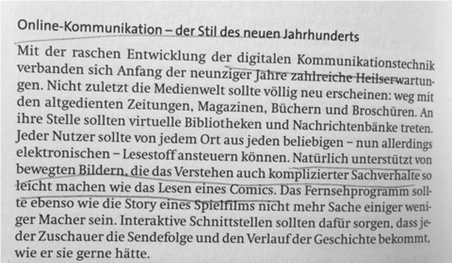
“Natürlich unterstützt von bewegten Bildern, die das Verstehen auch komplizierter Sachverhalte so leicht machen wie das Lesen eines Comics.“ / “Eventually, supported by moving images which facilitate the understanding of complicated subject matter as if you were reading a comic.” Remember, the book is from 2005. This was the year that I started my university studies in. Since then, the world seems to have turned upside down in the sense of the so-called visual turn. Everything is now about “moving images” first and text second. Much of this seems to be about understanding and about making complex subject matter less complicated to understand. I argue, however, that stories can be simple in any format, also in writing — black on white.
Sure, there is bias in this. I do not know how it is that some people end up as writers, some as dancers, and others as painters. The truth is: We are all the same — we put stories on stage or online. The process that gets you there is the one that creates all the value. Seeing beyond people, seeing beyond the visible stories, feeling what is underneath. This is all that stories can depict. If you have the gift of “writing” stories in this way, people come to you and want to “read” them, even if the “text” is represented in images in the end.
From the perspective of the artist, however, I am excited about trying to write with a visual representation mode in mind. This is not so much because I think the story needs to be told differently. It is rather the excitement of trying something new that builds on the existing deep expertise. If writing for clips and movies is so different in the end, I will have to find out. If it is a more immediate and more powerful tool to reach people’s hearts and minds, let’s do it. Whatever it takes to create moving images in the minds of people, I will do it. As a storyteller, you have no choice.
You have to write from the bottom of your heart.
Reflection Questions
1) Are you a visual thinker or which media format is most appealing to you? Can you explain how this might have come about?
2) Which digital media channel are you not interested in at all?
3) Do you think that movies can really make complex things more easy to understand? Why?
Schreibe einen Kommentar