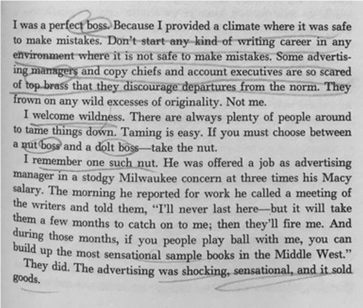
Story behind the Passage
When talking about leadership, you usually also talk about “bosses.” That was very evident in our group discussion yesterday. Everyone practically had one (stereo-)typical leader in mind when describing leadership qualities — even unconsciously. What I think about a lot these days is the question of inborn leadership and also entrepreneurship qualities. This issue of “being a born leader” is basically as old as mankind. It started with studying the behavior of Roman emperors and Western aristocracy and is now stuck at the point of studying the inability to lead on behalf of contemporary politicians. But for me, looking at this from an entrepreneurial perspective now, the entire discussion gains new momentum — not because there is some new debate about it in research but because I look at it equipped with different experiences than before.
I did not expect such huge differences between leaders (in existing organizations) and leaders in entrepreneurship. The latter term is actually superfluous because an entrepreneur is a leader per se. The company of the entrepreneur would not exist if he/she had not taken the leadership position of starting it in the first place. Later on, when the company is up and running, many of the leadership tasks on a daily level are not that different from the ones of other executive leaders — from the outside. From the inside, however, there remains a crucial difference. As an entrepreneurial leader, you constantly think about developing your business. Business practically is the same as development, movement, infinite creativity…
What made me think of Bernice Fitz-Gibbon was actually not the leadership issue today. It was the fact that she already cared a lot about financial education which is also on my mind right now. But when I opened the book today, I simply had to take up her words about “the bosses.” There used to be a time when I tried to avoid being a “nut” by any means. But if I had held on to this self-created ideal, I would never have started anything, I guess. As an entrepreneur, you have to be yourself. And I am certainly a nut — that is just the way it is. I would not say that all entrepreneurs are nuts. I know some that are quite the opposite. Still, it all depends on your personal definition of “nuts” characters.
My Learnings
“Because I provided a climate where it was safe to make mistakes.” That is something that I definitely do but I am convinced that many people say this. The way it works — just like leadership itself — is to be the living example. Many people can say “I provide that kind of climate.” But saying is not doing. Most of the time, it does not help to claim that you are creating an atmosphere of trial and error, even if it is meant that way. So, you have to make mistakes yourself (which everyone does as a human being) and, this is the important thing, you have to admit it openly. That is the tough part but if you are a nut, that is absolutely key.
“I welcome wildness.” I guess, being wild is my brand. The problem is, I do not even notice this most of the time until others remind me. And by now, i feel quite fine about it.
“There are always plenty of people around to tame things down.” That is so true. But it is equally true that it does not take many people to change this. It takes one nut to bring a kind of energy to the room that makes a difference. If there is one person who flips the atmosphere upside down and who shows that anything is possible, other people start seeing it. It does not mean that all people join, but some. And that is the spirit that especially entrepreneurs automatically pick up on their journey. If you live as an entrepreneur, you always give everything. There is no “taming.” You have to give it all and you give more and more easily as you learn. If you have dolts around you, they hurt. Therefore, keep Steve’s words in mind and grow into the boss you already are:
“The people who are crazy enough to think they can change the world are the ones who do.” — Steve Jobs
Reflection Questions
1) What kind of boss are you/would you like to be?
2) How do you protect yourself from the influence of people who “tame things down”?
3) Do you openly share when you make mistakes? How?
Schreibe einen Kommentar