# 23 SPECIAL (Part 2): The Myth of the Professorship as a “Calling“ and How You Can Become Who You Really Are
CONTINUED FROM YESTERDAY (Read Part 1)
What is a real mission?
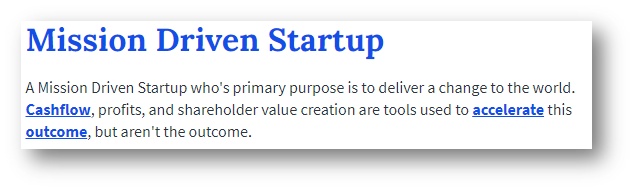
As you can see above, the concept of “mission” is used for businesses as well, including startups. In the following, I will transfer this concept to the individual level to delineate it from my discussion about the professorship as a calling. Even though this might sound like a mere wordplay with pseudo-religious career terms, my choice of mission over calling seeks to emphasize that both are linked to some subjective sense of purpose. But, as I clarified yesterday, the calling is based on external interference and mission is something that you actively choose to embark on. So, let us begin.
Let me start by clarifying what a mission is NOT: One particular job! A mission (or purpose), at least from my experience and perspective, is usually related to a set of skills in line with your value set and passion. All I am going to write about this is based on x number of books that I have read on the topic and x number of people that I talked to and x hours of coaching I got and conducted with clients. All this at least brought me ahead on my own journey and I want to share my thoughts.
What I need to explain in the first place is the difference between knowledge and skills. This might sound really basic but since most people in universities never really worked anywhere else, this is exactly the right point to start with: Knowledge for me consists of theory and practice. Practice you gain by applying your knowledge. That involves action. And action means: You do something. So, let me use the example of a former housemate of mine in the U.S. to explain how mission, knowledge, and skills go together:
C.’s brother had been suffering from a very rare muscular disease since childhood and this became the engine behind her mission: to help find treatment for this illness. She studied biology and during our time as housemates she was doing research as a postdoc in the university lab. Every morning — and I mean every morning, including Sundays — she got up very early to get on her bike and cycle down to the lab to feed the mice for the experiments (yes, I know, animal rights, etc., but that is not the point now). She did all her work with utmost concentration and endurance. Even though I did not know her very well, I remember her as the most dedicated and determined scientist I have ever met. She loved what she was doing, you could tell. She had a sense of purpose and she would never complain about her research life, even when things went wrong with the experiments and she had to start with an experiment all over again.
Now, you might go like: “Oh, and what now, has she become a professor? If she was doing her postdoc many years ago, she should now be a professor, right?”
Wrong question to ask!
As far as the facts go, I think she still does research at a university lab but was never interested in walking the professorial path, including teaching and administration. Why? This is exactly where the aspect of mission gains meaning in relation to your skills and preferences. If it is your mission to help heal a rare disease, this is a really big mission you are embarking on. However, when it comes to missions, there really is no ‘big’ and ‘small.’ This is pure judgement and makes no sense because any mission in life is just as important and valid as any other. If you feel your mission is to help children or contribute to our knowledge of the universe or grow an ant farm… who could ever judge what is more “important” if this is the purpose you have found for your life?
This is the point at which you could get confused. You might be saying now: “O.k., if nobody can judge my mission, my inner ‘calling’ of becoming a professor is just as relevant and cannot be judged.” No, not exactly! The example above also takes us one step further with respect to my clarification of how your mission, i.e., your real “calling,” if you will, is related to your skills. In my example above, my housemate did work in a university lab because this was the place that allowed her to do research. It provided her with the education and infrastructure to pursue her mission. If she had had the same mission but different skills and talents (the aspect of talents needs to be dealt with separately, they are not “God-given” either), she would not have been able to enjoy this work. You need to like sitting in a lab all day, carefully handling tiny utensils, taking responsibility for equipment and living beings, calculating and measuring, writing research papers, and many other things.
Here is the interesting question now: If my housemate would have a different skill set, what difference would that make for her mission?
Answer: 0!
You can still have that mission of helping heal a disease but there are numerous other jobs that allow you to do this. You do not have to be a researcher, you can manage a lab or a hospital, you can become a physician who directly helps people, you can be a sales person for the respective medication, you can be a secretary or an assistant for people in the lab, you can be an architect who helps design labs specifically for this kind of research, you can be… Are you getting my point?
The mission has NOTHING to do with the particular position or occupation you have. But the position very much determines your work conditions, your routine tasks, your responsibilities, the culture in your work place, your work hours, the mindset of your colleagues … Basically, all this determines how you spend your life time EVERY DAY! This is not a minor issue, as all of you know. And it becomes a huge issue if you feel that 80% of the stuff you are doing every day run counter to your skills and the things you enjoy doing. As I said above, it does not matter for the time being why you have certain skills and why you struggle with others. Yes, you can learn much but there will always be things that run counter to your ‘nature.’ You can love this or hate this but the point is: It is impossible to fundamentally change it at a certain age.
O.k., now, what does all this say about the “real calling,” i.e., your mission? It basically tells you that your mission is something that you can figure out (and most likely already have without even knowing it) completely independent of a particular kind of job. And this finding now also allows you to go back with your thoughts to the myth of the “professorship as a calling.” If I am saying above that the position has nothing to do with the real mission, it consequently means that being a professor IS NOT a calling. It is a position — that is it. But there are thousands of other positions that would allow you to live your true mission in a way that is more fulfilling because these others positions meet your skills and preferences much better.
Now you will go: “No, not really, there is no other job that allows me to read novels all the time, do research in the library, and teach students, except for jobs in publishing houses and museums, maybe.”
Bullshit!
First, ask any professor of yours and interview him/her about what he/she really does on a daily basis. You will be lucky if these people still remember when they last read a novel (I mean, a new one, not from their standard course compendium). Instead of going into this resignation mode of “professor is the only thing I can imagine for my career,” please pause for a second ask yourself: What is your real mission?
Let us start with this example that I hear very often when talking to students in Literary/Cultural Studies: You love reading books and discussing them. Ask yourself:
- Which PERSONAL INTERESTS make me read so much?
- Which SKILLS allow me to read and discuss all these books?
- Which SKILLS do I build and develop while reading/discussing/writing about books?
- Which special KNOWLEDGE has reading brought to my life?
- What do I DO with the knowledge that I gain from the books?
If you want to pass on your knowledge, this means your mission is somehow related to TEACHING, for example. This might be your mission but then again, what does teaching mean? For most people I meet in the academy, teaching is instantly related to some idea of a teacher-student or professor-student relationship in a classroom setting. Are you serious? Do you think being a school or university teacher is the only teaching job out there?
As I show in one of my other articles “We Are All Educating Teachers” (in German: “Wir alle bilden Lehrer aus”), teaching means helping others learn how to learn. Today in the middle of the digital transformation, lifelong learning is the number 1 skill for anybody, including employees in any field. So, again, go back to your idea that teaching is your mission. In which other positions outside academia are your teaching skills relevant to create impact? You have no idea? See, this is where you need to catch up on some learning about the work world. I will give you three examples (out of many more) of work fields in which your knowledge and skills as scholars from the humanities will increasingly be needed in the years to come:
- Organizational learning
- Communication, including but not limited to Public Affairs, Public Relations, and Marketing (Storytelling)
- Coaching and Consulting
It is not my goal to go into the details of these professions in the remainder of this paper. For now, I just wanted to clarify that the equation calling = position is wrong. And the thing that you need to pay attention to when trying to find the place where you can turn your mission into action is: skills. Unfortunately, this aspect has been neglected for a long time in the higher education system.
How to Become Who You Really Are?
This subheading sounds a bit confusing but it still reflects what I want to finally get at: We live in an age where the separation between work and life is increasingly being erased. I would argue, this separation has always been more or less artificial because people who have found their true mission and learned how to live it never really separate between life and work. You just cannot do this at some point. Speaking of my own example, people sometimes ask me how much I work in a typical week. The answer is: I have no idea!
(Almost) everything I do during the day is somehow related to my mission of bridging the gap between academia and the public, between the humanities and business. So, the only time when I do not really pursue this mission is when riding the horse, gardening, hiking, walking the dog, or whatever else I enjoy doing. But I do take calls, answer e-mails in-between, and think about new ideas and projects (if I feel like it). What I am saying: For me, there is no separation between work and personal time. I have different roles but all these roles are connected to my larger mission. The same values and beliefs drive all my activities.
If I were working in academia full time, however, I would definitely know when I am working because I would count every freaking hour of doing stuff that I do not enjoy doing or that I see no purpose in (at least in “traditional” professorship positions where there is hardly any chance to live my strengths). Just take this article: I am sitting down here on a Saturday morning (and now Sunday evening, Part 2) because I want to revise and finish this piece. Since I started writing about an hour ago, I think I have roughly produced half of this paper so far. And that does not feel like “work” in the sense of suffering and struggling. It feels like fun because I am doing something that I enjoy and that keeps my brain busy. If nobody ends up reading this, it is o.k. I am creating value for myself by writing and that value is called pleasure.
Before going on and on with all these more or less theoretical debates here, let me add some specific suggestions for things that you can do RIGHT NOW to find out what your future job might be if, by now, it has become clear that being a professor is NOT a calling. It can even be a cage in which you sit as the prisoner and you do not allow yourself do get out and look around. If you feel like this is a pretty accurate description of your present situation, here is what you can do.
Take a walk first or sit down right away with a piece of paper or your journal and take some notes on the following questions:
- When people come to you and ask for your advice (colleagues, friends, peers), what is it they usually want? What exactly do they hope you can help them with?
- Which resources allow you to help them with their concerns/questions? (a resource can be anything, e.g., knowledge, experience, skills, contacts, talents, ideas, things of any kind …)
- How did you get access to these resources and/or how did you learn the skills involved? Think about the big picture, not just education, think of life as your school. Where did you pick up the things that obviously create value for others?
You can see that all these questions very much focus on your unique personality traits. You cannot separate them from some artificial professional persona. They basically reflect “who you are” — from the perspective of others and from your own perspective (this is a simple way of making my point here, I will write about the problem of ‘identification’ in some other post). And really take the time to reflect on the image others have of you. This is the key to your strengths. It does not matter right now if you can exactly explain why people have this idea that you can help them with a specific task. It simply matters that you take note of it. This mirror that others provide is a key to understanding your true mission. It is usually something that has been with you all the time, even long before you even knew what professors do and how you get such a position if you want it.
So, I encourage you to actively seek this feedback by asking others what they see in you. You will be surprised about their perspective. And do not interrogate or theorize or whatever. Above all: Do not judge! Instead, encourage them to tell you their honest thoughts about you and be quiet. Listen and absorb. This is not a dissertation defense (an interesting concept, by the way) or any sophisticated bullshit battle about academic terms. Take it as a gift and let it sink in. Your own thoughts about their feedback will automatically follow and you can relate those to the questions I am asking above.
Whatever comes out of this little experiment for you will help you walk the next steps — if you want to. Of course, you might come to the conclusion that everybody else is not seeing who you really are and that being a professor is still the only option for you when it comes to your future career. O.k., this is your decision. Walk this path then and enjoy it. But please, do not communicate to others, especially to your students and fellow researchers, that this goal of yours is a “calling.” No, you just noticed that I mentioned the word “decision” above. And that is what it is. Your mission might be given to you by life and continuous practice, e.g., the ability and passion to teach others. But the wish to do this in the position of a professor is your decision. That might be taken as a tiny detail but it makes all the difference in the world.
Decision making, unfortunately, is something that has really taken a turn in academia where I see no improvement very soon. I am not even saying that hierarchies are the only problem. In fact, I do see some movement there. But the decision-making processes in universities are just so slow that they kill most innovation from the seed (no matter how valuable democratic committee decision-making might be). A toxic mixture of many different aspects then leads to this deteriorating situation in which young scholars end up truly believing that they have no control over their own careers at all because all the decisions are made for them — or rather, against them. This probably also explains to you why I started out with this definition of the German expression for being appointed to a professorship (“getting a call”) . All this leads to what psychologists and coaches call: lack of self-efficacy. You feel you have no power over the outcomes of your actions. You are acted upon. How sad this erroneous thinking makes me feel.
Final Remarks and Practice
The goal of this piece (Part 1 and 2) was to show you paths towards reframing your mind in a way that you understand that YOU are the one making decisions. Even if you are exposed to the most difficult situation, it is always YOU making a decision on what to do with this. It sounds harsh but that is the law of resonance and of cause and effect. If you analyze your life and career according to this logic, you will find out that who you really are and who you can be in the future is completely independent of any pseudo-metaphysical bullshit talk about a professorship as a calling. Yes, universities and monasteries share many similarities but in both cases, it is up to you if you enter or stay out, if you remain inside or leave.
I am going to leave you with one more practical exercise:
Think back of all major milestones that you have achieved in academia so far (e.g., your B.A., M.A., publications, successful exams, oral presentations and talks, study semesters abroad, scholarships you won…). Make a list of those and for every point, write down exactly the steps that were necessary to complete/achieve them. And I mean: exactly. You start with first hearing about this particular challenge or option and then you write down every step that followed. Then look at all this. What is your insight?
Feel free to share your insights. I am curious.
Reflection Questions
1) How do you feel now after reading this? Pause for a moment and try to identify your feeling(s).
2) Think of one job that you find interesting outside academia. Write down on a piece of paper: a) What a typical work day would look like in this profession (from 8:00 a.m. to 7:00 p.m.), b) which people you would probably be working with (colleagues, clients, partners), and c) how much money you would make in a month.
3) If you become a professor, what is it that you would like to stand for?
Schreibe einen Kommentar