Story behind the Passage
Whenever I make big leaps in terms of personal growth, science gradually plays a more important role. This in and of itself is “growth” because when I was younger, I did not care about science at all. Not that I neglected it — I simply did not think about it that much. It was different when I was a kid. Back then, I could have imagined becoming a scientist. I loved dissecting bugs and photographing plants. I guess, school sort of changed that — as is the case with so many things that people/kids love. They love them for their own sake and they love learning more about them and then, by the time they attend school, they start hating their former fields of interest because their teachers are telling them they are too stupid to understand what they actually love.
How cruel that is.
And how much damage it does to the economic potential of an entire nation.
Not even speaking of the personal dreams that get killed.
So, right now, again, science is becoming one of the major topics in my life. Usually, there is another topic that serves as an entry point and then I know exactly where to start with my reading. It is funny how I never noticed this pattern in the past — at least not that consciously. But what I am also increasingly aware of is how university studies help you structure your learning and filter relevant information, particularly readings. Still, I think that my other topic (I am going to talk more about that whenever the time has come) allows me a narrower selection of where to start.
The book by Slingerland has been sitting on my shelf since I did my master’s thesis, I think. I cannot remember. The title What Science Offers the Humanities is quite funny, though. It sounds as if the sciences have to convince the humanites that they hve something valuable to offer. Nowadays, I would rather say that the opposite holds true — that the humanities could or even should explain what they have to offer the sciences. Or maybe that is just my interpretation. I do not want to go into this anyway. What I simply want to talk about is this aspect of unity or the lack thereof. When I think of the sciences nowadays, I think of the natural sciences in particular. And that is connected to the laws of nature for me. If you think “laws of nature,” it is funny how the plural actually is in the way but probably correct. For me, nature is this one coherent system, the only thing that is really whole and united. Still, the plural reveals that there is not just one big mechanism underlying this.
It makes sense to me.
My Learnings
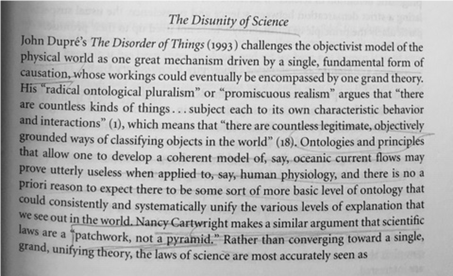
“Ontologies and principles that allow one to develop a coherent model of, say, oceanic current flows may prove utterly useless when applied to, say, human physiology, and there is no a priori reason to expect there to be some sort of more basic level of ontology that could consistently and systematically unify the various levels of explanation that we see out in the world.” That is quite a long sentence but it is not as complicated as it might appear. First, “ontology” means “the study of being and the essence of things” (Etymonline). So, there is hardly any field of study that goes deeper than this, even within the discipline of philosophy. Understanding this term already pretty much explains the rest. Why would there be one and only one ontology that explains the one mechanism?
Maybe it is a human quest rooted in our DNA that we hope to find THE ONE AND ONLY THING that will explain our entire being to us. Maybe it is just overambition or insanity or hidden narcissism which makes us hope one of us will be the lucky one to discover it. I do not think that will happen, exactly because of the explanation given above, i.e., that there are many laws to discover and many ontologies underneath them. Still, what I do find exciting is the question of transferability. In other words, can we transfer the workings of one mechanism in nature and apply them to other things, e.g., technologies or even the human organisms, as is stated in the example?
Today, I looked at many books in the field of biomimetics. That is very much related to the quest described above — looking at how we can “mimic” nature to use it for our technological advancement. I have not started reading the books but I definitely know that I am excited by this. Whenever I discover a new label, a new field of study, it endows curiosity with a name and therefore also draws certain boundaries. Boundaries are a good thing, most of the time. Since I love connecting dots and seeing patterns in things, I am quite sure that this field will be exciting for me. It also seems to fit in with Slingerland’s topic — the connection to the humanities. But that is not my guiding theme. I simply want to find out if I can somehow connect whatever I learn about biomimetics to the little scientific knowledge I have. The nice side effect is: I will grow further because nothing makes you grow more than learning in a field that you have exactly “0” idea about.
Happy Learning!
Reflection Questions
1) What do you first think of when you hear the term “science”?
2) How do you think about the “disunity of science” and the possibility that there are multiple ontologies?
3) What is the most fascinating technological invention according to your opinion?
Schreibe einen Kommentar