Story behind the Passage
What can you do best? The answer to this question is the basis of your business. There is only one problem: If your best skill is problem solving, you need to know which problems you solve best. Or is this question not important at all? I had two conversations about this problem today and the answer is: ???. So, I decided to consult the Business Dictionary to gain more clarity. I cannot say that this worked out but I can at least write about the issue.
My Learnings
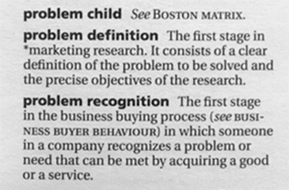
“Problem Child.” This concept is quite funny. It is from the Boston Consulting Matrix and describes what some might also remember as “Question Marks” in the upper right hand corner of the graph. It refers to small businesses that derive in a rapidly growing market environment but still have small market share and thus consume a lot of cash.
On some days, I do feel that this is the right label for my business.
“Problem definition. … It consists of a clear definition of the problem to be solved and the precise objectives of the research.” I love this part of problem solving. It is the essential step of solving any problem. When you are solving the problems of other people/clients, this stage depends on listening carefully and of asking the right questions. Both aspects seem simple but they are not. They are just interdependent. If you do not listen well, you are not able to ask the right questions. If you just listen carefully without asking questions, you will not get to the core of the problem.
What I find quite funny is that the business dictionary talks about “research” in relation to problem solving. I totally agree that problem solving involves research of some kind. It does not always have to be “formal” research, i.e., based on scientific studies. It is also a kind of research if you search for answers in your brain or in your treasure box of professional and life experience. Wherever you look, the answers need to come from somewhere.
The crucial difference between solving problems in research and solving problems with research is that the latter case involves action. Hence, the term “answer” most importantly involves: very specific steps that need to be taken to fix them. If you are the one implementing this solution, these steps will immediately be related to your personal skill-set. This can be a big problem in two different ways. A) If you have very few skills, you can hardly fix any problem without the help of others. B) If you have very many skills, you are in trouble as well.
Why?
“Problem recognition. The first stage in the business buying process … in which someone in a company recognizes a problem or need that can be met by acquiring a good or service.” This third paragraph answers the question why having many skills is not really helpful for defining and solving problems with your own business. If you see many different problems and you can even fix them — which problems do you focus on? The answer to this question is easy if you have sales or cost reduction as the guiding principle: You fix the problem that promises you most business value. This is a simple economic principle that practically guides most decisions of humans — in business and in life.
The latter issue is easy but communication gets in the way. Usually, the client has to know beforehand which kinds of problems you solve best and then he explains his problem in detail. If he does not know anything about you and your business specialization, people do not trust in your problem-solving ability. This is how business works — usually.
But this is not how I work, unfortunately.
This is also why I had to change the order of communication. The best thing is to not say anything about the kinds of problems I solve. I just ask about problems first and then I shoot with ideas — the IDEA MACHINE.
The Idea Machine takes me back to the outset of my post today because it is a solution to a problem itself. If you have helpful answers to many problems, you just need to get access to all the problems out there. This sounds easy but it is quite hard. The only thing you can do to facilitate the process of formulating problems and questions on the part of those who have the problems is by offering easy communication channels. Maybe this will make it easier — maybe not. Maybe I just see problems where there are none…
Reflection Questions
1) What is the biggest problem you solved so far in your job? Which indicators told you that you actually solved it?
2) Do you like problem solving?
3) Is there a particular skill which you usually apply for practical problem solving?
Schreibe einen Kommentar