Story behind the Passage
The title of the book choice today is actually real bullshit in light of the passage above. Is that a bit too critical? Well, of course, but let me explain. I opened the book today because I wanted to find the title of a coaching exercise that I once learned before my actual coaching training. Instead of finding the exercise in the book, however, I found this quote on the first page, above the imprint. And then I knew I had all I needed to make my point today. This point was once again triggered by an online “blind date” I had with another academic.
“Yaaaaawn…, booooring people talking about boring stuff!” Is this what you are thinking now?
As you know, I can very well understand that skepticism. I am also super critical of super intellectual bullshit talk. But, you know, there are exceptions sometimes — even though I myself hardly believed in this anymore. And whenever this happens, you notice it immediately. From the first second onwards, there is energy flowing from one to the other. You can feel it in virtual space. It is like waves of energy flowing back and forth, almost like pingpong. One person speaks, the energy flows, and then the other person receives, converts, and sends more energy back — in words and gestures and thoughts.
“Is this becoming a porn post now or what?”
Well, intellectually speaking, maybe! What I am describing is a fascinating phenomenon and it is one that does not happen everyday, which is why it is such a treasure and a topic to write about — especially among academics. Especially in this environment where people put so much energy into trying to sound and look smart, much energy is usually lost (or just not there in the first place…). Not so in conversations like this one and we actually also addressed this aspect because it is related to what we think about in our work. There is this (virtual) space that gets filled with passion and joy, I would say, that can trigger new things — whatever these might be.
“O.k., so why “100 Coaching Exercises” then?”
Before I get to this, let me make sure that I am not accidentally pissing off the wrong people. In case Martin Wehrle, the author of the book, ever reads this blog (which is unlikely to happen, I guess), I do not want him to get mad at me because I am bashing his book. Not at all, the book is valuable. I often look at it when people ask me about coaching and training methods. Books give things names and you can find them on printed pages and refer others to them. So, that is all great and helps. What I want to talk about, however, is that it actually does not take these 100 and even more tools if you want to do what the quote says and what I experienced today. And this is a major essence why I am calling the post “sparks” today.
What it takes for these sparks to be discovered is not a book or some training. It only takes one thing which is not easy to attain and which also requires practice. This thing is called presence. When I say “presence,” I do mean it in the spiritual way. Presence means you are fully in the moment. You are fully aware of your own body and mind, while also feeling the presence of the other. You see things through the lens of the other person while you follow his/her words but you are still completely focused on your peace of mind. You listen, you watch, you feel.
“Wow, now Silke is really becoming esoteric.”
No, let me just explain to you how all this relates to the quote and to the coaching exercise.
My Learnings
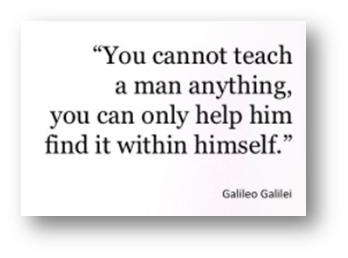
“You cannot teach a man anything; you can only help him to find it within himself.” To be clear: I strongly share this view, even though it runs counter to the idea of writing or reading books about tools or knowledge for personal development and learning. But the most fundamental advances in your development, the really deep knowledge and even wisdom you gain, does not go back to some “knowing” in the rational sense. Rather, these insights must be felt — with your entire being. Most of these deep insights have nothing to do with things or topics in the outside world. Instead, they have to do with you. They are connected to the things you love. This is exactly where the academic blind date and the coaching exercise converge.
This exercise which I did not find in the book today was called “searching for lights.” At least, this is the name I remember from almost ten years ago. There are probably 20 different names for it. But it does not matter what it is called. It is important that you can do it — at least as a coach, but also as anybody. It means that you pay attention to the sparks that somebody else is sending out while speaking. These sparks are caused by the passion the person bears inside. And the place, the physical place where you see them, is in the eyes. This is where the magic happens — where passion finds its outlet.
The way you do this in the exercise, the ‘detecting,’ is easy. You keep asking open questions. And then you watch, with all your attention. Today, which is the reason why I am even talking about this, I witnessed many sparks. But I also caught a moment in which the exact opposite happened — a shift from sparks to very rational speaking. We were in complete flow, talking about what we obviously love thinking about (yes, for some people, thinking is fun, it is brainfuck, try it out!) but then I asked a question which slightly went into a different direction and I could immediately see the response — the sparks in the eyes disappeared for a few seconds. It was not dramatic and it did not completely destroy the flow of our conversation but I noticed it. I noticed that there was less passion in this activity that I had just inquired about.
This is exactly why the quote is so powerful and why it caught my eye. It is another way of describing the message of the coaching exercise. The fact that true knowledge is inside and thus needs “helpers” to bring it to the surface explains why other human beings are so valuable for your learning. These sparks, they can only be seen and reflected by others. Yes, you can practice sensing them too, but it takes time. And usually, your brain tries to boycott that. We very often tell ourselves that we are passionate about this or that because we for some reason want to be passionate. But, sorry to disappoint you, you cannot enforce this. It is not possible, your body and your eyes are the traitors. It is like wanting to fall in love with someone. You can talk yourself and maybe even someone else into it, but I doubt it will be deep and lasting.
For sure, the opposite, complete passion without rational thought, might lead you to some dead end as well. But you know what, where authentic passion and energy flows, there is usually no dead end because sparks combine thinking and feeling in a way that computers cannot. Doors open if you follow that path — even though you have no idea where the path is leading. Still, it helps to have companions on the way — people who help you “learn” by telling you what they see. This is exactly why ‘coaching’ cannot be learned from a book. It does not even take a coach. It takes a human being to watch you, to ask questions, to share his/her observations with you. This person can see the sparks in your eyes that you are missing. These sparks are your signposts.
So, my encouragement is not only to look for people who can do this for you — who are midwives to your personal learning curve. My message is that you become this person for others. It does not take anything but your presence and your full attention. Oh, and one more thing: It takes your courage to actually trust what you are seeing and feeling. Energy and excitement is nothing you can measure. You will have to trust your gut feeling that what you are seeing has value for the person you are mirroring. This might not always be what this person wants to hear. But if you follow the sparks — your own and the one of your counterpart — it will lead both of you to a new place.
See, this is what blind dates among people who think with passion can teach you!
Reflection Questions
1) How do you think about the quote by Galilei?
2) Can you think of an example from an online meeting you had in the recent past in which you observed the sparks in someone you were talking to? Did you tell the person about it?
3) Who is your “mirror”? Who tells you what you are really passionate about without you even seeing it that clearly?
Schreibe einen Kommentar