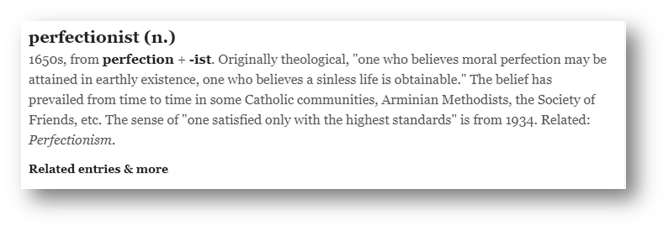
Story behind the Passage
Yesterday someone mentioned the problem of perfectionism in German culture. He also explained how perfectionism had held him back for a long time. Well, he did not actually say it had “held him back” but rather that it had prevented him from being more successful than he actually was (he was/still is very successful). And then it hit me. I totally got it all of a sudden. Not because I never thought about perfectionism before. I just thought that I had gotten rid of it already, many years ago. But now, the past weeks especially and his comment yesterday made me aware that this was an illusion. I am just in the process of really getting rid of it.
So, this is why perfectionism and its definition is so much on my mind today. To me, perfectionism is one of the most stupid unconscious mechanisms one can suffer from. It is the total lack of objective estimation how well you are performing. And the worst thing is not only that you spend more time on stuff because you are (unconsiously) seeking perfection. That is kind of level one perfectionism treatment to stop this. If you go beyond that, when really getting rid of it, you excel because all of a sudden you can handle five balls in the air at the same time. And you do so without feeling stressed out.
The image of the all the balls in the air also tells you why my headline has the “messing up” in it too. The perfectionist impulse now is to say: “Five balls in the air is at least three too many! You cannot do anything properly this way.” Bullshit! It is possible if you really get rid of perfectionism. But the tricky step that is necessary is to learn how to tell the difference between perfect and messing up, i.e., regulating the degree of “perfect.” That means you develop the skill of prioritizing in such a way that you hardly ever give more than 80% because that is usually enough. Sometimes you give a lot less because you calculate this makes sense. But then, in certain situations, you are easily able to devote a bit more attention because the situation calls for it.
All this frees up so much space in your life and career that all of a sudden, so many things pick up speed and happen simultaneously. And this traction is necessary to really become successful. You need several balls in the air because only some of them will end up bringing results. But this “space” that I am talking about only opens up if you stop thinking about this all the time. There, again, the topic of perfectionism comes in again. Only perfectionism makes you think about stuff all the time. “Oh, did I hand in the manuscript with mistakes? … Oh, did I reveal too much information in this or that meeting because I was not prepared well (according to my standards)? … Oh, why should I even apply to this job, I do not fit in perfectly…!”
When this kind of thinking stops, you are really on the next level of healing your perfectionism. Still, there is a realistic chance that you become too relaxed about everything and start messing up. And this indeed happens. I see it all the time. Many people end up doing shitty work. But I cannot tell if they ever aspired perfectism in the past and their sloppy way of doing stuff is only their way of dealing with this. In some cases, I guess, they never really did work that I would have considered “perfect” — or they never tried. But this now gets me on thin ice. There are many novelists, for example, who have revealed how obsessed they are about crafting perfect stories. And many of them are really successful. After all, there might not be ony way of doing things and there are different characters. So, for some, perfectionism might be the only path to success. Where am I on that spectrum?
My Learnings
“… one satisfied only with the highest standards” As I write and reflect on this topic, I feel how torn I am. Because I know that this satisfaction with only the “highest standards” has brought me quite far. It makes you learn more and do more than others who are always satisfied with the first result — the “just get it done” people. But I know that this exactly is the problem. And, of course, there is a good portion of arrogance in what I am saying here. Claiming that you are only satisfied with the highest standards means that you obviously claim higher ones than other people. This also means that you are judging other people. And the point is: This exactly makes you do nothing in the end because you constantly end up thinking you cannot meet your own expectations of this mystical high standard.
As always, I am kind of getting to the point here where I am leaving my original argument above. I was happy about the the feeling that the last layers of perfectionism are finally bursting. And now I obviously still holding on to them. So, that leaves the other option one always has in life: Why not just accept perfectionism as a personal strength and make the best out of it? But as I am arguing above, the “best” based on my standards of the “highest standards” does not result from perfectionist behavior. So, is it “only” a matter of quantity versus quality or can both be combined?
The only thing I know is that I have reached a new level of dealing with perfectionism. I guess, I just need more practice to figure out where it leads me. Since I have been trying too long to push things the perfectionist way, I guess there is no risk in trying the opposite. It is natural that this feels like only making mistakes at first. Naturally, there will be work that has more mistakes than I used to accept. But it is a matter of taking the risk of trying stuff and if there is one thing I totally agree on: We need more of a “mistake culture” (Fehlerkultur) as they call it in Germany, the culture of of trial and error (Is it not so funny or rather revealing that the term “mistake culture” does not even have a literal translation in English? The error outweighs the trial part of the word.). Otherwise, things will not move forward.
As always when I have no clear answer to my own question and no way of sticking to my original argument, I am going to leave you with a quote — this time from a professional martial arts fighter:
“Perfectionism is not as much the desire for excellence, as it is the fear of failure couched in procrastination.” — Dan Miller
Reflection Questions
1) How do you define perfectionism?
2) Which opportunities did you let pass because you thought your work would not fit “perfectly”?
3) Which recommendation would you give someone suffering from perfectionism?
Schreibe einen Kommentar