Story behind the Passage
Today I gave a talk at a conference together with a dear colleague of mine. I just had five minutes or so — but I used them. I had no idea what I was going to say beforehand. And then the words kept flowing. Even though it was one of these weird online events where you have no idea who is watching — if anybody is watching at all — I felt I was reaching the hearts of people. I know it sounds insane, but it was true. I feel like I made the point I had wanted to make without ever thinking much about it. I was just present, listened to what the others were saying, and all this together made me say what I said. It was very easy and the feedback I got from people afterwards confirmed that it was not complete bullshit. In addition, I enjoyed doing it with my colleague very much. I would never have learned about the conference in the first place had she not told me about it and we would not have had a project to talk about either.
Whenever I think about speeches, I mean, really great speeches, I think about Martin Luther King (MLK). Well, there are also many other people that come to my mind. But MLK is one of them. I think, if there is one great speaker that people from all walks of life know or remember, it is MLK. But maybe this is an illusion. Maybe this is just because I studied American Studies and we obviously deal a lot with U.S. speakers. Still, I do not see MLK as an “American” symbol. MLK represented humanism and peace — just like people such as Gandhi, Mandela, and Kofi Annan. Yes, they were born in a particular country and their stories represented the history of a particular people. But really, their words reached human beings around the world, exactly because they were not tied to a certain place or a certain group of people.
“Reaching the hearts of people” is what great speeches do. Mine today was not great, it was not even a speech at all. Still, it does not matter how long or short you speak, I guess. If you open your mouth and a few words hit the nerve, that is all it takes. Less is more, I have learned that much in business and in the art of rhetoric the same rule applies. The problem was that I had not known about the fact that this was a live stream session and that there were at least hundreds of people watching. I mean, yes, I could have prepared better but looking back at it now — I am quite happy I did not. Plus, it would not have changed anything about the words I used and the pathos I put into it. And, yes, pathos is not something overly dramatic. Pathos is simply what you need in order to really touch people. If you talk like a scientist without any heart, this does not happen. I am not saying that scientists do not have a heart or cannot give speeches. But in this academic bullshit arrogance atmosphere, people usually leave their hearts in the closet. They do that out of fear and for the sake of proection. Still, they do it.
If you stop doing that, your messages really gain momentum.
My Learnings
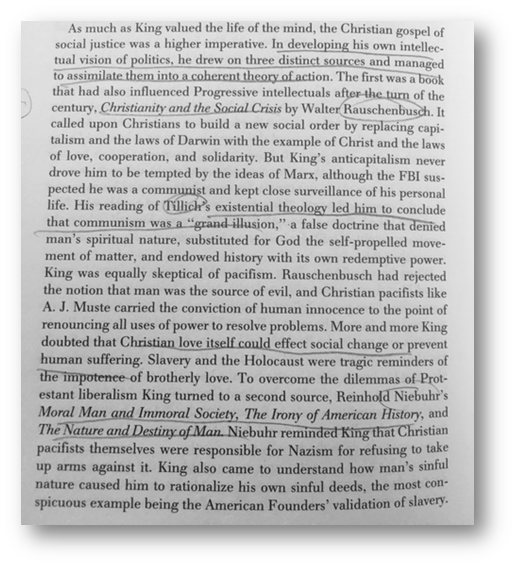
“In developing his own intellectual vision of politics, he drew on three distinct sources and managed to assimilate tem into a coherent theory of action.” You might wonder why I am talking about MLK as an orator and now I am choosing a passage that talks about his literary inspiration. But you know what? All I talked about today is the power of reading and the bond that is created between people who read the same text. This might sound weird or banal or both, but it is true. Everybody who seriously reads knows how much texts touch your heart and change your thinking. And the fact that MLK’s philosophy can be traced back pretty clearly to a series of literary/spiritual works does not surprise me in this context.
I can still remember in which course I bought this book. It was recommended to me in one of my earliest courses on American Culture Studies in university. I was one of these students who tried to buy all books that the professors or lecturers recommended in addition to the ones given in the syllabus. I wonder if students still do this or if any of my classmates did this? I did not have too much money back then (that is not different from today) but somehow I must have realized early that books would be the things that would teach me most. I have to add, however, that I have not bought the books that are mentioned in the passage about MLK’s intellectual development yet.
What strikes me most now that I am reading this is the fact that he was inspired by all the sources mentioned but he did not just adopt or copy each and every one. What he did instead was use it to develop his “own intellectual vision of politics.” I totally understand this and I wonder now what all my reading and thinking might lead to. Is it a vision of academia? A vision of humanism? Is it also a vision of politics? Whatever it might be, I guess, my readers and students can assess this best. And what I also want to underline or at least aspire is that this “theory” is one of “action.” This is also what I talked about today. If you want to stop climate change from happening, people need to take action. It is that simple. In order to take action, you need to realize why the hell you would even want to do so. So, “motivation,” this word which you find in any business self-help book, is always part of theory, even if people might not see this at first. You have to explain why you are even theorizing in order to convince people to actually listen to you and act according to your teachings.
Somehow I wonder now if MLK saw himself as a teacher. For sure, he was a preacher, even if he was not speaking as a church leader to the public anymore when he became the leader of the Civil Rights Movement. But for himself, from his perspective, did he see himself as a “teacher”? Nowadays, people usually tell you that you should not be teaching because then people feel like “students” and that is what people — supposedly — do not like. But I wonder if this really is true and if yes — why? I feel very blessed whenever I can be a student because that means I have found a teacher in someone. And this in turn means that someone can teach me something. This is a true gift of life. These situations can happen every day. You can learn from anybody around you. It does not have to be some “guru.” In some cases, however, there are really outstanding and fascinating people who really represent teachers in the most encompassing sense of the term.
What all these teachers that deserve the name have in common, at least from my perspective, is that they are great orators. This does not mean that they have to be particularly loud or articulate or that they give public speeches all the time. It just comes back to the fact their words touch you in a way that you cannot explain. And their words keep resonating in your mind — sometimes even for years, even your entire life. Maybe my talk today was somehow special. In the past, I always tried to reach people but it always felt like I did not quite get there. Today, I did not try but it did feel like this had happened. So, this confirms what Buddha, Gandhi, and probably also MLK knew: As soon as you stop trying, life begins…
Reflection Questions
1) What does MLK mean to you?
2) Are there books that influenced your thinking significantly?
3) What makes a great orator for you?
Schreibe einen Kommentar