Story behind the Passage
Today in the car, I was listening to the news on the radio. One thing they reported about was the fact that Frankfurt Airport was recovering from Covid because the economic performance is picking up speed again. Of course, there is still financial assistance from the state involved but the passenger numbers are rising and so are sales. No worries, I am not going into the environmental argument that much today, which could be expected when looking at the title. I do not want to talk what that means for the environment if people start flying like crazy again. In general, I am happy for the airport because it is the biggest employer in the region, even though I know of the environmental downsides. The reason why I am picking up this topic is a different one: Are we almost back to “normal”?
I find it fascinating how a pandemic that started as if the world was going under and that was defeated in the same way, even with constitution-unfriendly measures, is now quickly coming out of all this. This “back to normal” stuff is really happening faster and less noticeable as I had expected it. I wrote about this many months ago; the fact that human beings have this brilliant ability to forget many things at rapid speed. But right now, this collective memory loss seems to be happening to entire companies, as the airport examples demonstrates. Despite all the help they got and the holiday season now which brings passengers to he airport — how can this be that they are recovering to such an extent in such a short amount of time?
How can it be that “growth” is back as the overarching theme for human progress?
Yes, even though I am anything but a mathematician, I am aware that if you want to move from minus or zero, the figures need to “grow.” But this symbolic speech of back to normal indicates more than this to me. It means: back to chasing growth, even more than before, in order to make up for all the losses. Are we that insane? Do we all have Alzheimer’s? Or is this exactly the most positive mechanism inherent in human DNA that makes us so successful and supposedly superior — we can get over anything and return to exactly the same practices that once made us successful, thereby forgetting that they backfired at some point?
Hmmmm…
My Learnings
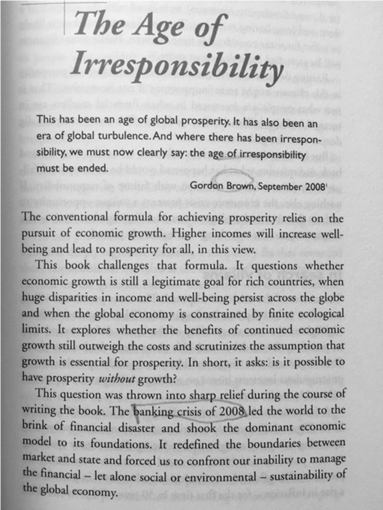
“It redefined the borders between market and state and forced us to confront our inability to manage the financial — let alone social or environmental — sustainability of the global economy.” Just to underline what Jackson is writing in the entire book. At the basis, as the subtitle states, is the assumption that the planet is FINITE, i.e., that it can break if we make it break by exploting it in many diferent ways. And I do not think this infinite state is just an environmentalist issue. My take on this is very broad. I do include human self-destruction in the model. As you know, I am very much concerned about the intellectual and social capital of the world population and my feeling is that, as we destroy our own intelligence and happiness, we are speeding up the process of destroying the earth.
Now, as as far as the sentence above is concerned, you see that Jackson tied his insights to the financial crisis of 2008. If you just forget about this context for a moment and read the lines from the background of the present world in the almost post-Covid world, you could still come to exactly the same conclusion. And there are three elements in this one sentence that I find quite interesting. The issue about borders, involuntary confrontation, and the inability to manage. Of course, it depends on your position of looking at everything but the connection between the three really becomes relevant when listening to news like the one I heard today.
As far as borders are concerned, I wonder why people still think they exist. After all, borders are human-made. No virus stops at a checkpoint. No animal walks around in the desert building fences or drawing lines. Yes, animals draw invisible fences by marking and protecting their terriroty but it is very clear that this territory and the respective borders are transitory. Human beings have this fatal tendency to declare borders for a lifetime. They set them up and want them to stay static forever. Of course, this is human because humans need physical borders in order to protect themselves from outside predators. What this mostly means is: from other people.
That might or might not be the case. The point is: For a long time, especially in he economic system, there have been no borders really. The internet age made them go a long time ago. But the interesting thing is that we artificially try to restore them. In all the talk about cyber security and even cyber war, we are implicitly saying that people are transgressing and actively violating borders where there are none. Yes, you have to come up with a clear definition of what borders mean. And if you include non-physical borders in the general definition, of course they exist. But they cannot be located that easily anymore. And if that is the case, they are hard to define in any way.
So, the reason why this is interesting is because of the confrontational aspect. Humans are lazy and we only act, at least most of us, if we really have to. We only started fighting the virus at the point when we really could not ignore it anymore. “There is a virus in China… Well, who cares. Oooops, the virus is HERE now? Let’s act!” And now, we are almost back to the ignoring phase again. What I am saying is that “confrontation” also alludes to the word frontier. That is a place where the battle is fought and there might be territory to get lost or won. But now comes the funny aspect in the sentence. Jackson is using the word not with respect to external places of trouble, he talks about our inabilities — human shortcomings.
When it comes to the inability to manage, everyone knows that I am a bit biased when it comes to Germany. There are many nations that have more management DNA in their blood. As always, this has something to do with culture. But not managing well is different from lacking the ability to manage at all, right? And this inability is really striking when it comes to the political sphere. This has, I think, become quite a prominent finding. But a detailed account of this would require a thorough re-reading of Weber and bureaucracy which I am not doing just for this blog post today. Still, it is interesting to note the significance that management skills have gained because of the immediate needs to confront and fight a viral enemy.
All this is not supposed to sound like a pessimistic lamentation. On the contrary; I wanted to draw attention to the issue of recovery, the growth paradigm, and imagined borders because I think, and this is missing in this “back to normal” discouse, nature’s law is not division without unity — it is division within unity. Our body cells split constantly, yet, that does not make our body fall apart. You can cut an offshoot from a plant to make it grow separately but still within the botanic eco-system. So, all I am saying is that we should still see that border-drawing is a tool for making the world a bit easer to manage and more structured to analyze but that should not make people forget that everything remains connected.
This is what the virus showed us.
Obviously, it has not taught us how to transfer this to our look at the world.
Maybe the ability to learn is also “finite” in human beings?
Reflection Questions
1) How do you define “prosperity”?
2) In which areas of life does growth matter for you?
3) What is the most important thing you learned from Covid?
Schreibe einen Kommentar