Story behind the Book Choice
I have not blogged for quite a long time. I know, I have said this before but I doubted ever blogging again about books. I still have not found the reason why I would go on. There were many reasons for writing before. I basically needed to write, it was an inner urge. So, writing was like therapy or addiction. If I do not need that anymore, why would I still do it? Why would I continue writing about books I am reading? Just to show people what I have read and how I think about it? Maybe! Maybe this narcissistic drive will never leave me. Maybe it will never leave any writer. Maybe writing is just part of me and I should stop judging myself.
Maybe…
Whatever I am thinking about it, I am back to writing. There still is this inner sense that everything will make sense in the end, even though I do not know how and why. And there could not be any other book more suitable than this one by Scott Peck to pick up on topics such as purpose and inner longing. Peck was an outstanding psychiatrist. But what makes him so special is not only the way he writes about his experience and his findings but the combination of psychological and spiritual wisdom. He is one of the few people who were able to build this bridge between these two worlds and the corresponding vocabularies and worldviews.
It took me some time to get back to this book in my shelf (and some others by Peck that I will write about in the near future). I think, people who enter this spiritual journey of finding out what “God” means to them — whatever that might be — really enter a hard road. And as far as I think, this road cannot be traveled without turning the many rocks that form your psyche. “Psyche” or “soul” is at the center of spirituality too. And with Peck, I believe that spiritual wisdom corresponds to psychological healing. I am not saying that one presupposes the other. I am somehow saying they go hand in hand. That is a bit fuzzy but as specific as I can get.
Peck’s book is a rocky road as well. This “road less travelled” is what it is because many people, I think, the majority, do not want to enter it. They do not want to shed light on the dark corners of their soul. But for someone who feels that he/she is suffering because there are many dark spots that deprive one of happiness, getting on this road brings much hope with it. I do not know what finally makes the difference, i.e., why some people get on the road and why others never will. Yes, suffering and the will to heal is one. But that cannot be the only reason because so many suffer and only very few get on the road of psychological self-discovery in combination with spiritual growth. Maybe there is something like “predestination” — some are chosen, others are not.
I will never be able to tell.
What I know is:
It takes a radical decision to get on the road.
- Problem
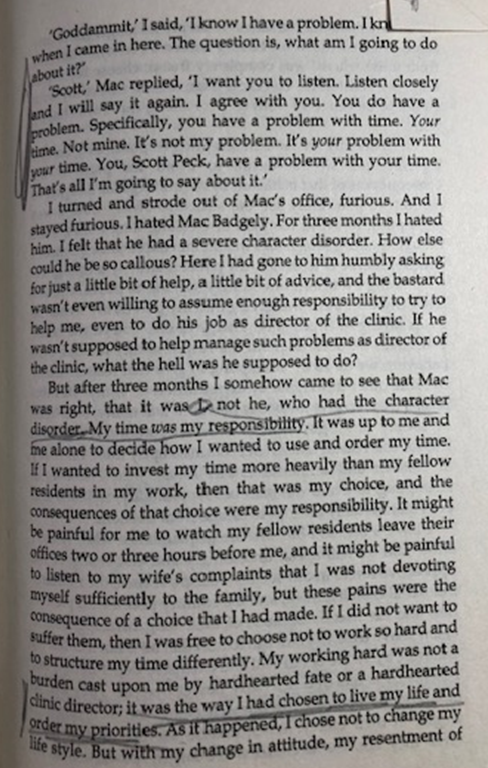
There is one secret to psychological healing, actually, to any healing. And Peck has the capacity to show that in a very powerful way by sharing this personal story. The first step to healing is one crucial insight: The insight that “you have a problem.” And the most important thing about this is the personal pronoun. As soon as you fully realize, you have a problem, it means that you are the one who is responsible to fix it — nobody else. Not your boss, your parents, your spouse, your siblings… This is where everything starts: taking responsibility of your problem and ultimately of your life.
As much as one can then learn about therapies and different ways of getting help, this most crucial insight and one’s self-obligation to stick to it remains crucial. In a radical way, this means: there is no blaming others, no whining, no self-defense. Whatever situation you are in, you made choices in the past to end up in this situation. And to every reader who now gets infuriated by what I am writing here, please note: Yes, there are so many things out of our control that have a huge impact on our lives and ultimately our well-being. Among these are deaths, others losses, illness, natural disasters, evil people who harm us, crimes, etc. All this is out of our control. But we are the ones who are then left with the choice of hor to respond. This is where the freedom of healing lies that is usually lost in trauma.
People who suffer trauma basically share one thing: The experience that nothing is under their control, nothing at all. And the major part of healing then is marked by the relearning that this is not true. Yes, there are outstanding situations in which human beings become the victims of outside forces. But this does not mean that one’s entire life is just composed of traumatic moments of losing control, of never again being able to get behind the wheel of your life again. But finding this balance again between control in the sense of acting to create positive things and letting go of control in the sense of letting life happen requires this major insight that one is responsible for one’s life. Yes, the things that happened in the past happened and coping with them does not mean either rejecting them or just turning negative things into positive ones by denying reality. It means the opposite: accepting reality. And accepting reality and therefore truth is the core definition Peck provides of mental health (32).
Peck’s story above of his own professional problem at the beginning of his career highlights this mechanism of taking responsibility of one’s problem and of one’s life in a powerful way because it is so close to our daily reality and our hidden psychological problems. Having too much work on one’s plate and then going about complaining and expecting others to fix it, is something most people can relate to. But Scott is brutally honest about his own mental flaws at the time. Even if the lesson that his boss teaches him here is painful, extremely painful, it is just as healing. He learns that it was his decision to take on so many patients and that he is the one who pities himself and envies his colleagues who go home to their families much earlier.
The interesting thing about the resolution of the problem is that Scott after realizing his own responsibility still decides to go on like this — by working way more than the others and also more than his family finds agreeable. But what changes is: He stops whining about it because his attitude changes. He realizes that it would be up to him to change the situation and that he could easily change it. But he consciously decides not to — because of his ambition, his relation to his patients, whatever. He simply accepts the driving forces behind the situation. As soon as you realize what is driving you and that your choice is your choice, you learn two crucial things: 1) You can change things. 2) In order to change things, you have to know what you actually want. Eventually, this allows you to stop blaming others for a certain situation and you can stop expecting others to fix it. And this very feeling of “injustice” and “unfairness” which causes so much depression is resolved by this very insight.
The problem that remains is: Many people are not willing to accept this.
They want to hold on to the pain that they are unconsciously causing for themselves by clinging to the belief that others are responsible and that these are bad people because they do not help.
It took me a long time to accept this flaw in my own thinking.
But I am not blaming myself anymore for having acted this way in the past.
Self-blame is another form of psychological violence against oneself.
Accepting and getting on the road to freedom is much more rewarding.
2. Love
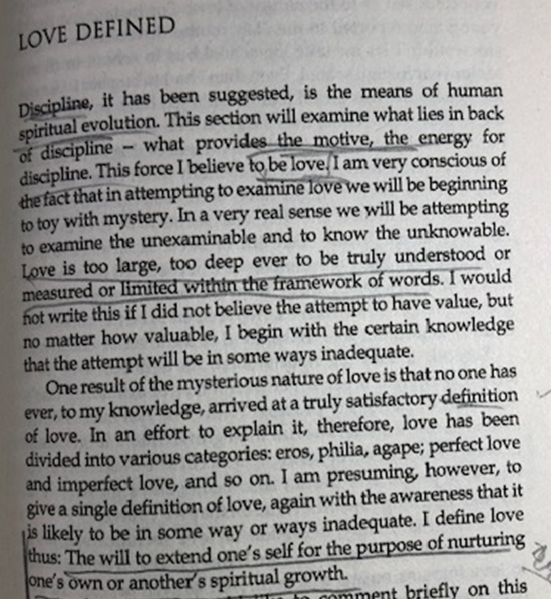
One might say that love cannot be defined, so the title of this sub-chapter might be called bullshit in the first place. But Peck does not try to take away the mystery of love and its complexity by providing this definition of love. Rather, he has to give some definition in order to explain how love is related discipline, a key element of his approach, and how this in turn ties in with spiritual growth and ultimately mental health. And his definition of love might read quite surprising to some:
“The will to extend one’s self for the purpose of nurturing one’s own or another’s spiritual growth.”
I will not try to explain how exactly “discipline” comes in here and what it means for Peck because this is quite a long and substantial part of the book and I would not do justice to his work by trying to squeeze in some short version here. What I simply want to point out is that this definition of love is one of the most valuable I have ever found. Yes, it is up to the experience of everyone to judge in how far this makes sense or not. According to my experience, it makes complete sense. And even more than that, it forms the purpose of life. As Peck states in the chapter “Cathexis without love”:
“The only true end of love is spiritual growth or human evolution” (95).
True, this sounds really “Christian” and that is exactly where the spiritual and the psychological world intersect, which is exactly why Peck’s book is so valuable. He never preaches any kind of dogma or theological ideology. But he makes one understand how core pillars of the Christian faith go hand in hand with mental liberation and healing. This is rewarding but never intrusive. The reader still has the choice to believe whatever he or she wants to believe in. And Peck never claims that turning towards “religion” is the ultimate way to heal.
3. Serendipity
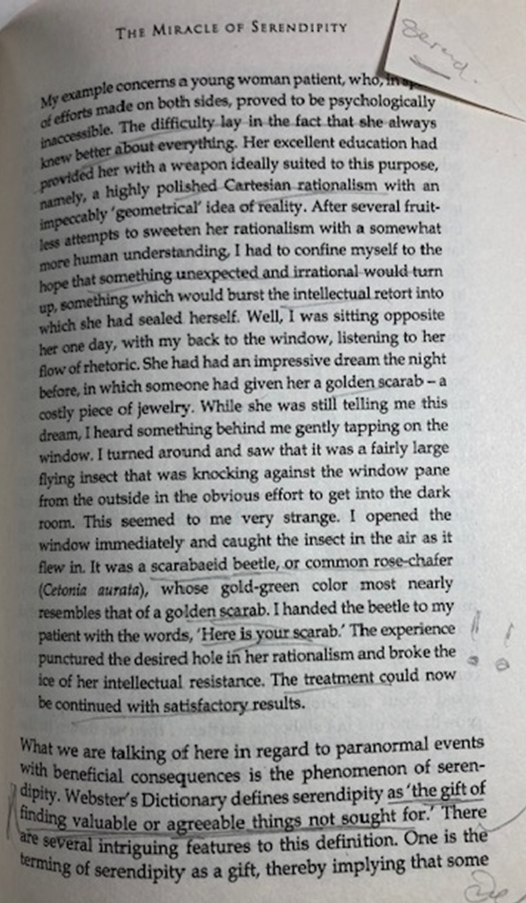
Serendipity is one of the words that I learned quite late. Someone mentioned the word when I was describing something I had experienced. And I do think that it is a key to happiness. The case Peck mentions here is about a patient who was so much into her rational mind that she would never have allowed for “serendipity” to enter her life. After all, it is something like a miracle — it cannot merely be explained by rational arguments. If we do allow for serendipity to happen, it blows our mind. And I think, we can more or less train ourselves to become more open to experiencing the transformational power of serendipity as “the gift of finding valuable or agreeable things not sought for.” Yes, it is a gift — the kind of gift children naturally have because they still have the ability to see wonders where grown-ups just see everyday life. It does not harm to embrace this childlike part of one’s identity.
Reflection Questions
1) Did you ever experience a situation where you unsuccessfully tried to convince someone that he/she was supposed to solve your problem? Could it be that you are currently facing such a situation without being aware of it?
2) How do you think about the definition of love which Peck gives — about love as the nurturing of spiritual growth (in yourself/in others)?
3) When did you last experience serendipity? If you cannot remember — could there be situations like this but you never looked at them this way?
Schreibe einen Kommentar